





 Download factsheet
Reuniting abandoned pups with their mothers
Read More
BIOSECURITY RISKS OF THE WET TROPICS
AFRICAN TULIP TREE
20 MAY 2026
WHAT IS IT?
The African Tulip Tree (Spathodea campanulata) is a fast-growing ornamental tree native to tropical Africa.
Easily recognised for its striking orange-red flowers, it was introduced to Australia as a garden plant but has become invasive in the Wet Tropics.
WHY IS IT A PROBLEM?
African tulip tree poses a significant threat to native ecosystems. It invades riparian zones, farmland, urban gardens and disturbed areas, outcompeting other vegetation and forming dense thickets.
Its dense canopy blocks sunlight, preventing the growth of understory plants and its flowers are toxic to native bees.
The tree produces large quantities of wind dispersed seeds, enabling rapid and long range spread. The tree suckers readily when disturbed or stressed, making it challenging to control.
CHARACTERISTICS
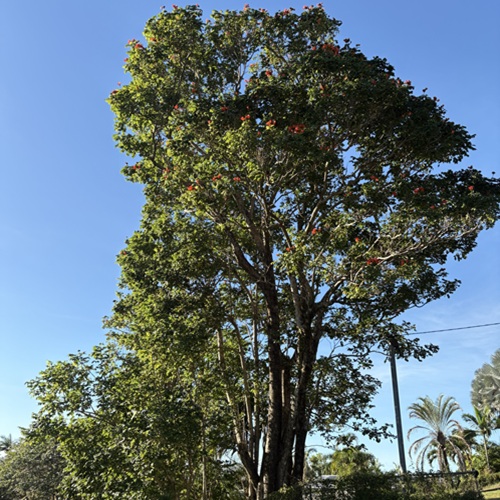
It is an evergreen tree that grows to over 20 metres.
It has broad oval-shaped leaves with distinctive veins. The leaves are bronze-coloured when young, turning glossy green as they mature.
Flowers are a large orange to red with frilled yellow margins on the petals. The papery seeds are wind dispersed and form in elongated pods, up to 20cm long, which split lengthwise as they dry
HOW TO SPOT IT ON YOUR PROPERTY
Look for a tall tree with a wide canopy, glossy green leaves, and clusters of vibrant orange-red flowers. The presence of seedlings in nearby areas may indicate an infestation or mature tree nearby.
WHAT TO DO ABOUT IT
- Prevention: Avoid planting African tulip and control/replace garden specimens with suitable non-invasive alternatives.
- Physical removal: Hand-pull freshly germinated seedlings.
- Chemical control: For established seedlings, saplings and mature trees, cut down and treat stumps with herbicide to prevent regrowth. Treat upper cut sections as well to prevent roots forming where it contacts the ground. No herbicide is currently registered for control of African tulip in Queensland. However, an off-label use permit (Permit No. PER11463 https://permits.apvma.gov.au/per11463.pdf ) allows use of various herbicides for control of environmental weeds in non-agricultural areas, bushland, forests, wetlands, and coastal and adjacent areas. Follow up control may be required.
RESOURCES:
Check out your Local Government’s Biosecurity Plan available through your Council’s website.
Refer to the Queensland Government Pest Fact for African tulip for detailed control information and herbicide rates.
RELATED NEWS

Removing pond apple
 admin@terrain
 September 23, 2026
Hundreds of pond apple trees removed at the Russell River...
Read More

Rediscovering native grasslands
admin@terrain
September 23, 2026
Grasslands were once widespread in this region...
Read More


