





What they are, why they matter and where they're headed
Read More
BUILDING FOREST RESILIENCE
NEIGHBOURS RESTORING UPLAND RAINFOREST
APRIL 2026
Neighbours on the upper Beatrice River near Millaa Millaa are banding together to revegetate riverbanks and restore critical wildlife habitat – doubling a landmark restoration effort in one of Queensland’s most ecologically significant landscapes.
When coral scientists Dr Mary Stafford-Smith and Dr Charlie Veron bought their riverside property, they saw more than grazing land. They saw a rare opportunity to restore a stretch of upland rainforest that scientists have identified as one of the region’s most important refuges against climate change.
Now, with support from Terrain NRM, the couple and their downstream neighbour Bruce Jenkins are joining forces to restore upland rainforest on their properties and reconnect critical wildlife corridors.
Veron family: ‘We have big plans for this land”
The Veron family – Dr Stafford-Smith and Dr Veron along with daughter Eviie and son Martin – own four adjoining blocks near the headwaters of the Beatrice River, with 1.5 km of river frontage and remnant upland rainforest. Their property is in a priority wildlife corridor linking Maalan National Park to Wooroonooran National Park and it’s also considered to be an important climate refugia – a potential haven for species as climate change impacts increase.
“We have big plans for this land,” Dr Stafford-Smith. “When Terrain NRM invited a range of scientists and practitioners along for an on-site planning day last year, it enabled us to start putting a plan of action together and make connections with people who can support us, including the Mamu Traditional Owners.”
Bruce Jenkins: Cattle and conservation
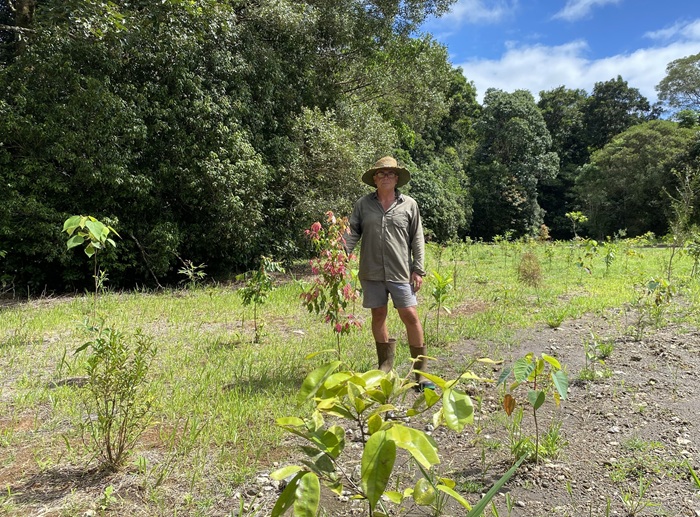
Their downstream neighbour Bruce Jenkins, a semi-retired pub owner from the Northern Territory, was also at the planning day. Mr Jenkins bought his 120-acre grazing property seven years ago and has been quietly transforming it ever since – fencing off the river and springs to exclude cattle, establishing a rainforest nursery and planting thousands of native trees beside the Beatrice River.
“I just love trees and the environment,” he said. “I want to leave this place better than I found it.”
Both properties are now being supported through Terrain NRM’s Forest Resilience project, which includes revegetation, weed control, conservation agreements and wildlife-friendly fencing along the river to exclude cattle.
Collaboration in a climate refugia
Project Coordinator Tony O’Malley said collaboration between neighbours in a climate refugia is what makes this project exceptional.
“Working with adjoining property owners like this is a rare opportunity to restore upland rainforest, which is one of the most threatened ecosystems in the Wet Tropics due to climate change,” Mr O’Malley said. “Adding Bruce’s property downstream completes the connectivity picture and means the results can be truly transformative for the regional landscape.”
Improving habitat, biodiversity, water quality
These actions will improve habitat in the Eastern Forests of Far North Queensland, a priority place in the Australian Government’s Threatened Species Action Plan, and they will benefit a suite of threatened and iconic species including lemuroid ringtail possums, spotted tail quolls, Lumholtz’s tree kangaroos, southern cassowaries, upland rainforest frogs and rare bird species.
The restoration will also help to reduce sediment runoff in the Beatrice River, which flows into the Johnstone River and then out to the Great Barrier Reef.
The Forest Resilience project is funded through the Australian Government’s Saving Native Species Program.
Terrain NRM supports landholders across the Wet Tropics and Tablelands to protect and restore their land through funding, technical advice and expert connections. Landholders interested in finding out more can visit terrain.org.au
RELATED NEWS
Lowland Tropical Rainforest
 admin@terrain
 April 15, 2026
Improving the condition of endangered forest types
Read More

Restoring upland rainforest
admin@terrain
April 1, 2026
Neighbours double the impact by both restoring wildlife habitat.
Read More


