





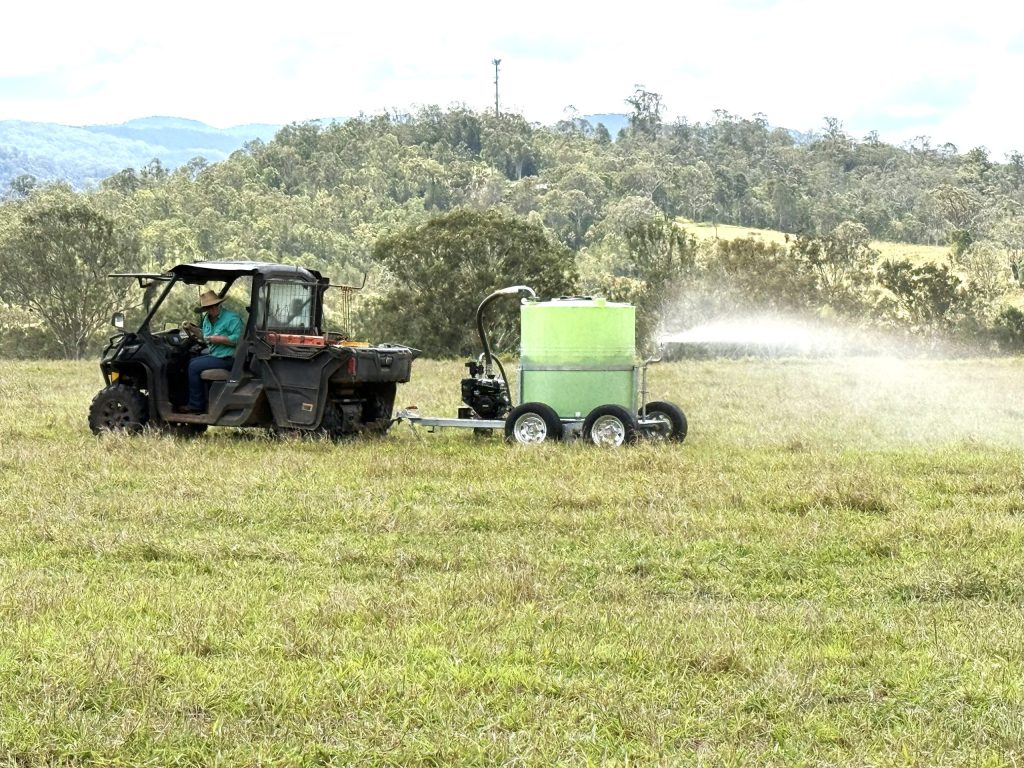
Working with farmers to trial a new type of sprayer for this region...
Read More
HERBERT INTEGRATED PROJECT
FERAL PIGS, WOODY WEEDS PROJECTS
JANUARY 2026
Feral pig and woody weed control programs are beginning in the Herbert catchment as Terrain NRM and its partners intensify efforts to improve water quality in a river system extending from west of Mt Garnet to the floodplain around Ingham.
Five projects are now being rolled out as the first stage of the Herbert Integrated Project’s on-ground works, and Terrain NRM Project Manager Fiona Barron said there were more to follow.
Council leads feral pig control program
One of the first is a feral pig management initiative led by Hinchinbrook Shire Council.
“Feral pigs are a major problem for the environment and also for the sugar cane industry and other farming industries in the Herbert,” Ms Barron said. “Pigs churn up soil and vegetation and damage wetlands and riverbanks, which releases nutrients and can spread pathogens.”
Hinchinbrook Shire Council will build on an existing control program by using emerging surveillance and control technologies, including AI-enabled cameras. A remote-triggering feral-tech trap door will also be trialled near a coastal community where traditional systems have been unsuccessful.
Woody weeds removal in Upper Herbert region
In the upper Herbert, stakeholders identified the thickening of invasive woody weeds, such as lantana, as a priority.
“Dense thickets of woody weeds are a problem for graziers because they lead to less soil protection and pasture,” Ms Barron said.
“Part of the project will involve working with graziers on trials of different burn approaches at different times of the year to determine the most effective way of tackling woody weeds so that we can share best practice with other landholders.”
Whole-of-farm and whole-of-catchment planning
Other projects include developing a whole-of-catchment management plan, supporting cane farmers through integrated whole-of-farm planning led by Herbert Cane Productivity Services Ltd, and synthesising past and present water quality monitoring data to better understand what’s happening across the catchment and help farmers and the wider community.
Circular economy, natural capital opportunities
There will also be a focus on circular economy opportunities and natural capital capacity-building within the Herbert catchment area.
Ms Barron said the Herbert Integrated Project was being driven by the community, and Terrain NRM was working with a wide range of partners and community groups.
“We have engaged widely with stakeholders across the upper and lower Herbert catchment to understand how the catchment can be managed as one integrated system – to not only improve water quality but also deliver broader community and landscape benefits,” she said.

“For over a decade, farmers and the agricultural sector have achieved substantial reductions in nutrient, pesticide and sediment runoff to the Reef through improved land management. This new investment will extend that, and explore more opportunities to generate social and economic benefits for the community.
“The Queensland Government is investing in place-based approaches to reef water quality, which means the people who live and work in the catchment and who know the landscape best are helping to shape the initiatives we deliver — and viewing the catchment as one connected system.
Community-driven projects
“Because the project is community-driven, we can also leverage this investment to deliver social and economic co-benefits for the local community and First Nations people. It will help to create a legacy of stewardship for the future.
“A healthier, more sustainable catchment is better for everyone.”
The Herbert Integrated Project is funded through the Queensland Government’s Queensland Reef Water Quality Program and delivered by Terrain NRM in partnership with many stakeholders including Hinchinbrook Shire Council, Herbert Cane Productivity Services Ltd, Canegrowers and TropWATER.
Find out more about the Herbert Integrated Project here: https://terrain.org.au/what-we-do/waterway-health/herbert-integrated-project/
Find out more about the Queensland Government’s placed-based integrated projects here: https://www.qld.gov.au/environment/agriculture/sustainable-farming/reef/reef-major-projects
RELATED NEWS
Climate Smart Funding for Wet Tropics farmers
 admin@terrain
 August 3, 2025
New trials, demonstration sites, workshops...
Read More

Soil Health workshops
admin@terrain
July 3, 2025
Great to see farmers from across the industries...
Read More


