





Tips for living next door to Spectacled Flying-fox roosts
Read More
GROWING GREEN CONNECTIONS
RECONNECTING & RESTORING WET TROPICS FORESTS
JANUARY 2026
A $2 million investment in forest restoration will expand wildlife corridors and help to reconnect forests from the Daintree to Ingham.
The Queensland Government is funding a three-year Green Connections project focused on private properties in wildlife corridors and strategic rehabilitation areas, and on building both environmental and economic resilience for the Wet Tropics region. It’s being delivered by Terrain NRM in partnership with landholders, Traditional Owner groups and community groups.
Terrain NRM’s Dr Karen Bettink said more than 60 hectares of land would be restored through weed and pest control and assisted natural regeneration of species, and over 10 hectares of land would be revegetated.
Improving forest connectivity between the Daintree and Ingham
She said improving forest connectivity from the Daintree to Ingham, and from the coast to the Atherton Tablelands, was increasingly important given the escalating climate and biodiversity challenges being faced in the region and worldwide.
“The Wet Tropics is recognised globally for its ecosystems and species, many of which are found nowhere else in the world,” Dr Bettink said. “But many of these are under threat from introduced weeds, pests and diseases, habitat loss and fragmentation, and a changing climate.
“Fortunately, we have many landholders and groups passionate about improving habitats and the condition of their land.
Part of our goal to reconnect and buffer world heritage areas
“This project will build on the great work already being done, and it stems from our broader Green Connections strategy to create corridors and to buffer and improve existing vegetation with the aim of helping threatened species from the southern cassowary and mahogany glider to Mabi and littoral rainforest.
“It will also help to increase carbon sequestration and generally make our ecosystems more resilient for future generations and economies.”
Eleven ecological corridors, strategic rehabilitation areas identified as priorities
Eleven ecological corridors and strategic rehabilitation areas have been identified in the Wet Tropics as a priority for concerted restoration efforts.
Dr Bettink said marginal farming land would be part of the project.
“This includes waterways, low-lying areas and steep slopes, where restoration can be blended with and complement agriculture. In these areas, biodiversity corridors can also act as windbreaks for stock and they can help to stabilise stream banks.
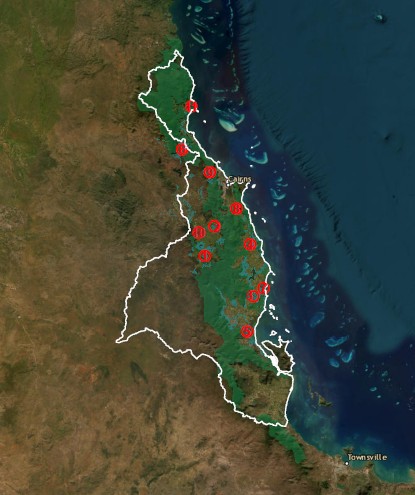
Areas identified for concerted restoration efforts.
“This work also creates jobs, supports local businesses and provides opportunities for landholders in nature repair markets.”
Expressions of interest from landholders
Terrain NRM recently called for expressions of interest from across the region for partnership projects on land considered a priority for extending or rehabilitating green corridors.
Dr Bettink said 47 applications had been received – from landholders, community groups and Traditional Owners.
“The response has been very positive, and we are now working through the applications and next steps. We want this project to be as impactful as possible, so we are looking for land that ticks at least two of these boxes – it’s in a Wet Tropics ecological corridor, a strategic rehabilitation area and/or a biodiversity planning assessment corridor and it’s home to a threatened ecological community.”
In the Wet Tropics region threatened ecological communities, or forest types, range from lowland tropical forest along the coast to Mabi forest on the Atherton Tablelands.
The Green Connections Project is funded by the Queensland Government’s Natural Resource Management Expansion Program.
RELATED NEWS

Green Connections
 admin@terrain
 January 15, 2026
A $2 million investment to help reconnect forests...
Read More

Tradition & Tech Team Up
admin@terrain
December 15, 2025
Scientists and Indigenous Rangers count Spectacled Flying-foxes
Read More


