





 Download factsheet
Reuniting abandoned pups with their mothers
Read More
BIOSECURITY RISKS OF THE WET TROPICS
HIGH BIOMASS GRASSES
4 MARCH 2026
WHAT ARE THEY?
High biomass grasses, like Gamba grass (Andropogon gayanus), Guinea grass (Megathyrsus maximus), grader grass (Themeda quadrivalvis), thatch grass (Hyparrhenia rufa) and giant rats tail grass (Sporobolus pyramidalis and Sporobolus natalensis), are introduced grass species that grow rapidly and produce large amounts of vegetation.
These grasses were often introduced accidentally or as pasture grasses for grazing but have become invasive after escaping from cultivation.
WHY ARE THEY A PROBLEM?
High biomass grasses outcompete native vegetation, reduce biodiversity, and alter fire regimes. Their high biomass creates huge fuel loads which generate intense fires that can destroy ecosystems, threaten wildlife, and damage property.
They also invade agricultural lands, reducing productivity and significantly increasing management costs. Many species are not palatable to stock so they can have a two way impact on pastures.
HOW TO SPOT THEM
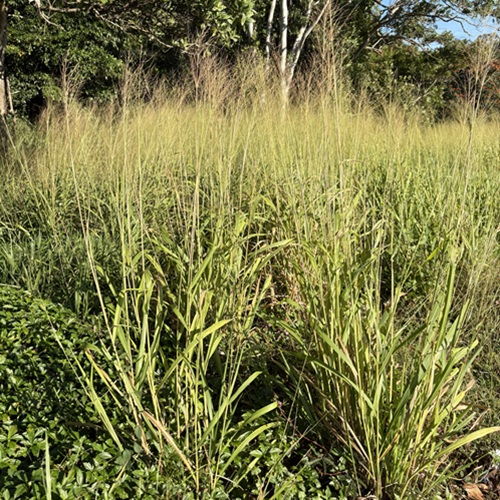
Look for tall, dense grasses with distinctive seed heads and rapid growth. High biomass grasses can dominate disturbed areas, roadsides, and pastures. They may initially turn up in places where materials like soil have been imported from other areas, or where seed has fallen off vehicles, machinery, raw materials or animals.
Early detection is the key to prevent more seed being added to the system.
CHARACTERISTICS
Gamba Grass
A large perennial grass which grows up to 4m tall, forms dense tussocks, and has broad leaves with a white midrib.
Guinea Grass
A large tufting perennial grass which reaches 3m in height, with long, narrow leaves and pyramid-shaped seed heads.
Grader Grass
An annual tufted grass up to 2m tall, with distinctive reddish-brown stems and fan shaped seed heads.
Thatch Grass
A perennial grass up to 3m tall, with smooth leaves and tangled, thatchlike tufts and long stems with distinctive dark bands.
Rats Tail Grasses
Rats tail grasses such as giant rats tail grass have distinctive cylindrical seed heads and tough, rasp like leaves which make them unpalatable to stock and other grazing animals.
 WHAT TO DO ABOUT IT
- Prevention: Monitor for new growth and avoid introducing these grasses by following best practice weed hygiene measures. Ensuring other materials, machinery, and vehicles arriving on your property do not bring these grasses in is equally as important as ensuring seed does not leave your property.
- Physical removal: Hand-pull or chip out and bag small infestations and dispose of material securely. Record locations where control has taken place so you can follow up in the future.
- Chemical control: There are a variety of herbicides approved or recommended for annual and perennial grasses; follow label guidelines. There are some on-label herbicides available for controlling grasses ; however, an off-label use permit (Permit No. PER11463 https://permits.apvma.gov.au/per11463.pdf) allows use of various herbicides for control of environmental weeds in non-agricultural areas, bushland, forests, wetlands, and coastal and adjacent areas. Follow up control may be required.
- Fire management: Reduce fuel loads by slashing, grazing or undertaking cool season-controlled burns before herbicide application or other control measures.
RESOURCES:
Check out your Local Government’s Biosecurity Plan available through your Council’s website for the high biomass grasses which are a priority in your area.
Search for the Queensland Government’s information on the high biomass grasses in your area in your
favourite browser to access Pest Facts for herbicide rates and detailed control information.
RELATED NEWS
Removing pond apple
 admin@terrain
 September 23, 2026
Hundreds of pond apple trees removed at the Russell River...
Read More

Rediscovering native grasslands
admin@terrain
September 23, 2026
Grasslands were once widespread in this region...
Read More


