





Reuniting abandoned pups with their mothers
Read More
ENDANGERED AND IN NEED OF HELP
MOUNTAIN-TOP MISSIONS FOR FROGS
SEPTEMBER 2026
Would you climb a mountain to help save a critically endangered frog? A new project in the Wet Tropics will take a team of field officers to the top of not just one but five densely rainforested mountains to check on six threatened frog species in the wake of Cyclone Jasper.
Terrain NRM’s Dr Andrew Dennis says he’ll do it in a heartbeat. He discovered one of the species – the tiny mountain-top nursery-frog – on hikes up Mt Lewis with his cousin Michael Trenerry 40 years ago, and he’s been at the forefront of actions to save it from extinction.
Helping six critically endangered mountain frog species
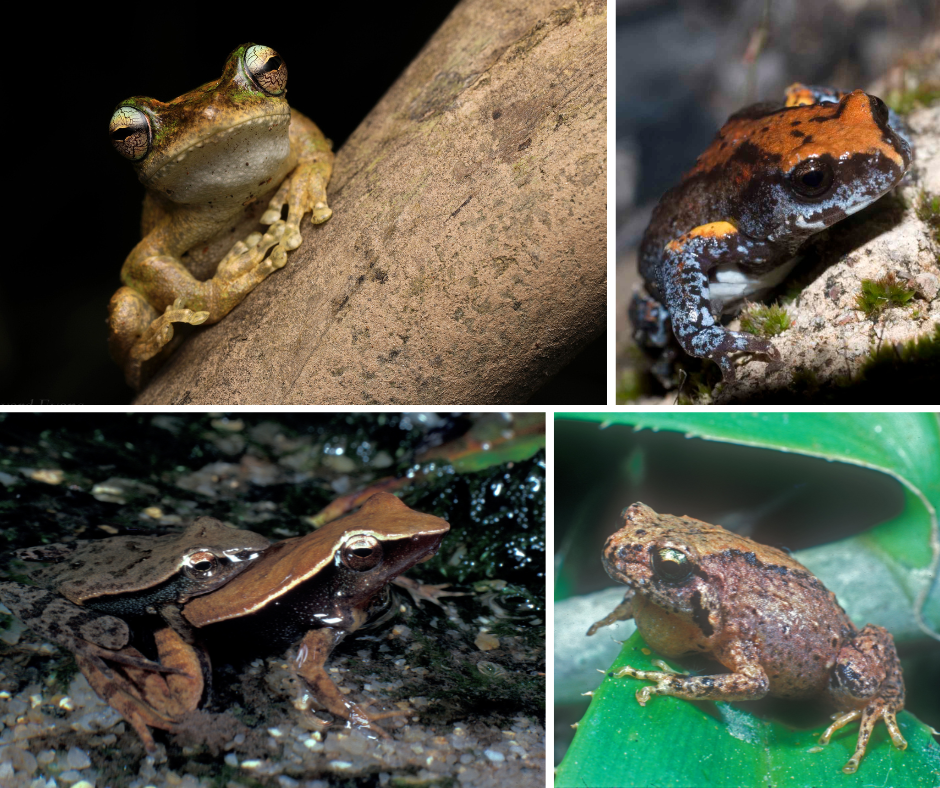
“Most nursery frogs are tiny – smaller than two centimetres,’’ he says. “These six species live at the top of our highest mountains and they’re a very special group of frogs that lay their eggs on land and hatch as fully formed frogs rather than tadpoles.
“They’re all listed a critically endangered because the areas they live in – up high where it’s coolest and most moist – are getting smaller in a warming climate. These frogs are no longer breeding in the lower parts of their range. And feral pigs are coming up higher, disturbing their habitat and adding to the pressure.”
Terrain NRM field officers will be working on Mt Lewis, Mt Bartle Frere, Mt Bellenden Ker, Thornton Peak and the Windsor Tablelands, and along creeks in the Kuranda area as part of the new project which will include feral pig surveys, trialling new feral pig baits and bait stations, audio monitoring of frogs, and exclosure fencing to protect breeding areas from pigs.
The project will also include revegetation work along Kuranda streambanks that were damaged by floods after Cyclone Jasper, to look after another threatened frog – the Kuranda Tree Frog.
It follows a recent project focused solely on the mountain-top nursery-frog, which showed how intervention can help these threatened frog species. A team from Terrain NRM, Western Yalanji, Gulf Savannah NRM, the Queensland Parks and Wildlife Service and James Cook University monitored the mountain-top nursery-frog (Cophixalus monticola) at the top of Mt Lewis for a year.
Dr Dennis says results from exclosure fencing trials – to protect breeding sites from feral pigs – were encouraging. The new project will continue this work to see if it is beneficial to add exclosure fencing around a newly discovered breeding area.
“We’ve seen the recovery of walking stick palms (Linospadix apetiolatus) which are used by these frogs to call from when they’re mating,’’ Dr Dennis said. “Leaf litter – used to lay their eggs under – is thicker. Seedling diversity is changing and more frog calls have been recorded.”
Trialling innovative pig baits
A key part of the new project will be finding a bait that will attract feral pigs and also be viable in the wet, humid and densely forested habitat at the top of mountains. On Mt Lewis, field officers will be trialling several innovative baits and ‘hog hopper’ bait stations that can be monitored and operated remotely.
“Standard baits go mouldy and lose their smell up there,’’ Dr Dennis said. “We’ll be trialling worm juice combinations and aniseed oil mixed into non-toxic commercial baits, as well as bait stations with doors heavy enough that only pigs can open them.”
On the other mountains, pig activity will be measured and audio recorders installed. Terrain NRM will be collaborating with James Cook University researcher Conrad Hoskins on Bartle Frere and Bellenden Ker, where frog monitoring is already happening.
From the mountain tops to work at Kuranda
In Kuranda, Terrain will be working with conservation group Kuranda Envirocare, James Cook University, Djabaguy Rangers and Buluwai Traditional Owners to repair streambank damage and possibly plant trees and manage weeds.
The frogs in the spotlight for this project are the mountain-top nursery-frog (Cophixalus monticola), the buzzing nursery-frog (C. bombiens), Hosmer’s nursery-frog (C. hosmeri), the Bellenden Kerr nursery-frog (C. neglectus), tapping nursery-frog (C. aenigma), elegant nursery-frog (C. concinnus) and the Kuranda tree frog (Spicicalyx myola).
“Each of these frogs is only found in the Wet Tropics, and in specific restricted areas,’’ Dr Dennis said. “This project will give us a better understanding of their status since Cyclone Jasper and the actions needed to protect and restore refugia habitat for them.”
The ‘Critical Frogs – Vital Efforts: Recovering the Wet Tropics’ Most Threatened Mountain Frogs from Impacts of Tropical Cyclone Jasper’ project is funded through assistance provided by the jointly funded Commonwealth-state Disaster Recovery Funding Arrangements (DRFA).
RELATED NEWS
Removing pond apple
 admin@terrain
 September 23, 2026
Hundreds of pond apple trees removed at the Russell River...
Read More
Rediscovering native grasslands
admin@terrain
September 23, 2026
Grasslands were once widespread in this region...
Read More


