





Reuniting abandoned pups with their mothers
Read More
KURRIMINE BEACH LITTORAL RAINFOREST
PROTECTING CRITICALLY ENDANGERED LITTORAL RAINFOREST
One of Australia’s most threatened ecosystems is being restored through targeted conservation works at Kurrimine Beach National Park, safeguarding the largest remaining area of littoral rainforest in the Wet Tropics.
Often described as “where the rainforest meets the reef”, littoral rainforest grows close to the sea—typically within two kilometres of the coast—on diverse substrates such as headlands, sand and coral rubble. This rare ecological community is scattered along Australia’s east coast from far north Queensland to eastern Victoria and is listed as Critically Endangered under the Environment Protection and Biodiversity Conservation (EPBC) Act.
The Forest Resilience project is funded through the Australian Government’s Saving Native Species Program. The project applies a whole-of-ecosystem approach to improve the condition the Eastern Forests of Far North Queensland priority place identified in the Australian Government’s Threatened Species Action Plan 2022-2032.
Project Coordinator Tony O’Malley said Terrain NRM is partnering with the Queensland Parks and Wildlife Service (QPWS), Traditional Owners and other land managers to protect and restore this significant ecosystem at Kurrimine Beach.
“Since it grows along the coast, littoral rainforest faces significant development pressure, compounded by climate change, rising sea levels, storm surges and receding shorelines,” Mr O’Malley said.
“It’s important that we work together to protect what remains and plan for future growth so the forest can thrive.”
QPWS Resource Ranger Chris Roach said the littoral rainforest at Kurrimine Beach National Park is a high conservation priority.
“This is the largest remaining area of this threatened ecosystem in the Wet Tropics, making its protection critically important,” he said.
“Terrain NRM’s Forest Resilience project has brought land managers and Traditional Owners together to reduce the impacts of weeds and feral pigs, while supporting actions under the National Littoral Rainforest Recovery Plan.”
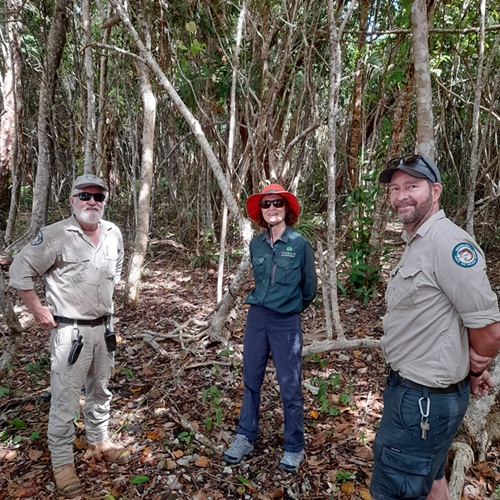 Mr O’Malley said weeds and feral pigs are the most immediate threats to the ecosystem.
“Invasive plants are a major issue, with many species washing ashore, particularly coconuts and Singapore daisy. However, this National Park is a rare stretch of coastline that remains largely free from coconut palms, which are dominating littoral rainforest in other areas,” he said.
“Feral pig trapping has also been a key focus. This coastline is an important sea turtle nesting area, and pigs pose a significant threat by digging up and consuming turtle eggs.”
Beyond on-ground works, the program is also building community awareness about the importance of littoral rainforest.
Terrain NRM has developed a dedicated online resource, including a booklet and location-based factsheets for littoral rainforest hotspots.
Local residents can help protect littoral rainforest by removing garden weeds, avoiding the dumping of green waste in bushland, and supporting restoration efforts.
DOWNLOAD: Factsheet: Kurrimine Beach to Cowley Littoral Rainforest
RELATED NEWS
Removing pond apple
 admin@terrain
 September 23, 2026
Hundreds of pond apple trees removed at the Russell River...
Read More
Rediscovering native grasslands
admin@terrain
September 23, 2026
Grasslands were once widespread in this region...
Read More


